


Get the most authentic gaming experience with Joysticks, Steering Wheels, and Flight Controllers
Why use flight controllers, racing wheels, and pedals instead of a standard gamepad?
Gamepads can work in a pinch, but for racing or flight simulation games that demand precision and realism, specialized controllers offer a massive upgrade. Whether you're piloting a jet, navigating a commercial airliner, or taking on tight corners in a Formula 1 race, the right hardware transforms your experience from casual to immersive. A properly equipped simulation setup lets you feel the road or the sky beneath you, something no standard controller can truly replicate.
How do racing wheels, pedals, and gear shifters enhance realism?
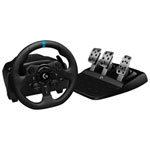
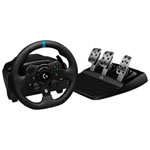
Racing games are some of the most popular titles across gaming platforms, and for enthusiasts, using a standard gamepad can feel limiting. A dedicated racing wheel brings much more precision and tactile feedback to driving games, mimicking the resistance and control of a real steering wheel.
But the immersion doesn't stop at the wheel. Racing pedals add another layer of realism by simulating gas, brake, and even clutch control. Some models replicate the feel of high-performance sports cars with progressive resistance and realistic spacing. For drivers who prefer manual transmission, a gear shifter peripheral completes the setup, allowing for clutch-gear coordination that feels authentic and satisfying.
Putting all of these components together can make your racing simulator feel like you're actually behind the wheel. Some gamers even mount these peripherals to full cockpit frames with integrated seats and display stands, creating an advanced home racing setup that mirrors real-world driving.
Why are joysticks and flight controllers essential for flight simulators?
Just like racing setups, flight simulators benefit greatly from realistic control systems. A flight stick or joystick allows users to replicate the movements of a real aircraft yoke or control column. Whether you're flying a small Cessna or a military fighter jet, the tactile feedback and range of motion offered by a joystick makes it easier to perform nuanced movements like banking, rolling, or pitch adjustments.
In addition to flight sticks, many simulation enthusiasts incorporate accessories like throttle quadrants, rudder pedals, and even modular control panels. These elements allow for realistic engine control, braking, and customizable in-flight commands. With the right setup, users can simulate every phase of a flight, from takeoff and cruising to final approach and landing with impressive accuracy and control.
Do these specialized peripherals offer better precision than gamepads?
Absolutely. One of the biggest advantages of simulation peripherals like joysticks, racing wheels, and pedals is the enhanced precision they provide. These devices are built to offer a wider range of motion and more granular control than the limited analog sticks on a gamepad.
For example, making fine steering adjustments with a wheel is far more natural and controlled than using a thumbstick. Likewise, landing a plane with a joystick that mirrors the feel of an actual aircraft column is far easier and more immersive than using standard console inputs. These peripherals are also designed to be more ergonomic, supporting better posture and reducing fatigue during longer sessions.
Can you customize your setup with programmable buttons?
Many racing wheels and flight controllers come equipped with programmable buttons and customizable layouts, allowing users to assign specific functions based on the software they’re using. This flexibility is ideal for advanced users or those building a personalized cockpit. Whether you're mapping radio communication to a toggle switch or assigning nitrous boost to a paddle, programmable inputs make it easy to tailor the setup to your exact needs.
Some high-end models even feature swappable components, LED displays, or software for in-depth configuration, perfect for those who want to replicate real-world control systems as closely as possible.
Are these controllers compatible with PC, PlayStation, and Xbox?
Most simulation peripherals are built with platform compatibility in mind, but it’s still important to confirm before purchasing. Some wheels, pedals, and flight sticks are PC-exclusive, offering deeper levels of customization and compatibility with sim software like iRacing or Microsoft Flight Simulator. Others are designed specifically for PlayStation or Xbox, and may not function properly outside their intended ecosystem.
PC peripherals often support driver updates and third-party configuration tools, making them ideal for enthusiasts who want to fine-tune their experience. Console-focused devices, on the other hand, tend to offer plug-and-play convenience with fewer setup steps. It's also worth noting that some premium peripherals are cross-platform, giving you more flexibility if you game across multiple systems.
Should you choose wired or wireless controllers?
Both wired and wireless options are available, and the best choice depends on your setup. Wired peripherals are generally preferred for their low input latency and consistent performance, especially in competitive racing or flight scenarios where split-second timing matters. They also eliminate concerns about battery life or wireless interference, though they do require more cable management and available ports.
Wireless controllers, meanwhile, offer a cleaner and more flexible gaming space, which can be useful for living rooms or shared setups. While some wireless devices may experience slight input lag, newer models have improved performance significantly, making them a viable option for casual to mid-level users.