Wooden Tool Sets
Discover the perfect blend of creativity and craftsmanship with our selection of wooden tool sets. Designed to inspire and educate, these sets are ideal for budding builders and imaginative minds alike. Whether you're looking to nurture a child's curiosity or simply want to introduce them to the world of hands-on play, wooden tool sets offer a timeless appeal that encourages learning through exploration. Crafted with care and attention to detail, these tools not only provide endless hours of fun but also help develop fine motor skills and problem-solving abilities. Explore our collection today and find the perfect set to spark a passion for building and creating.
Sort
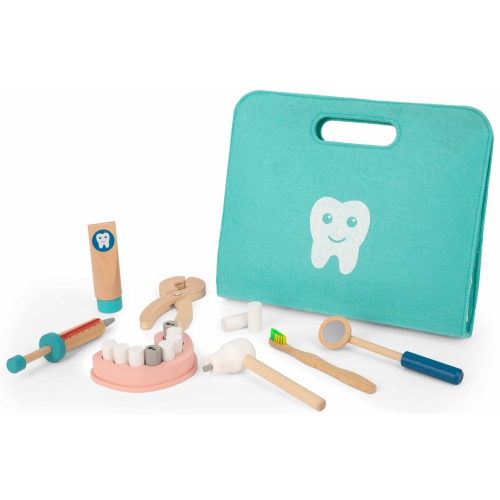
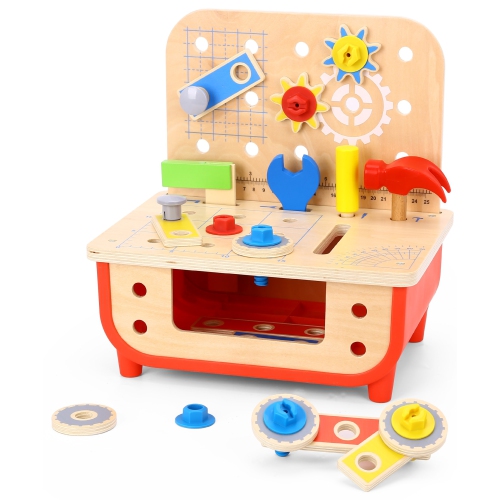
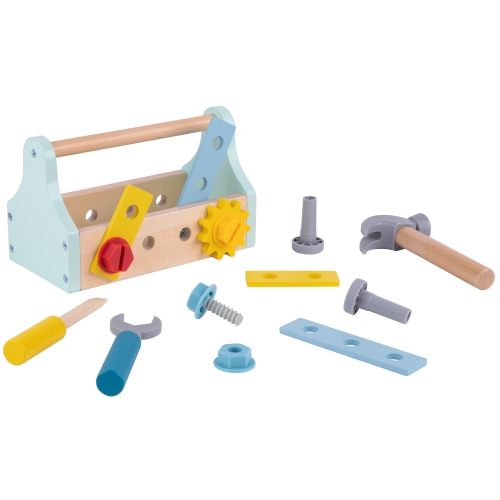

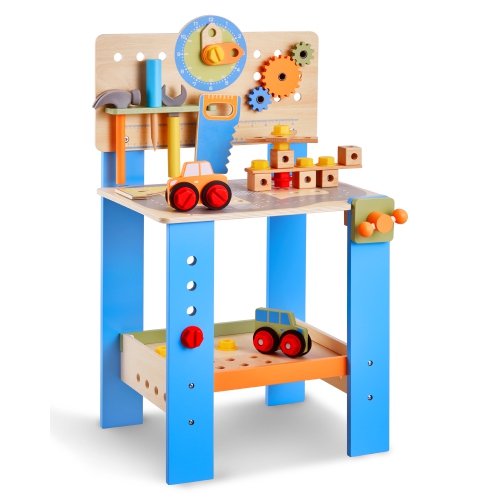
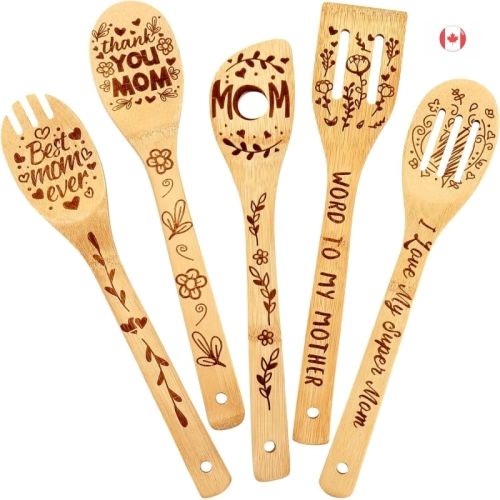
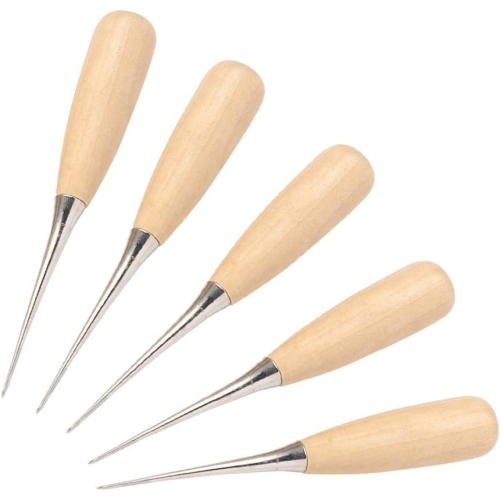

Pretend repairs give little hands a real challenge
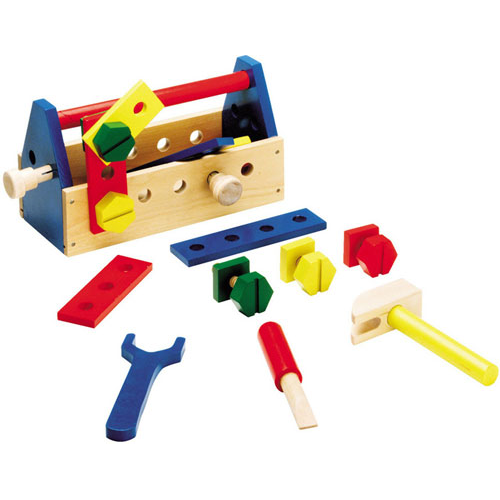
Wooden tool sets are children’s pretend-play toys that bring the familiar shapes and actions of a workshop into hands-on play. Typically built around toy hammers, screwdrivers, wrenches, nuts, bolts, and connecting pieces, they give children a way to practise turning, tapping, matching, and assembling without using working tools. Some focus on imaginative repairs, while others include drilled panels or building pieces that can be joined into simple structures. A child might tighten a bolt on a make-believe delivery truck, tap a peg into a bench, or line up tools before opening a pretend repair shop. These small actions create opportunities to practise fine motor skills and hand-eye coordination: one hand steadies a piece while the other turns a screwdriver, and fingers adjust their grip as a nut travels along a thread. Building play can also encourage problem-solving when children work out which holes line up or why a connection needs another turn. The appeal is not limited to completing a project. Sorting pieces by shape, naming tools, and explaining a repair can become part of the experience, particularly when a parent, caregiver, or sibling joins in. Wooden toy tool sets suit children who enjoy construction themes, copying everyday household tasks, and making up stories with physical objects. They also offer a screen-free activity with no fixed storyline, leaving room for a toolbox to become a travelling repair kit or a workbench to become a busy neighbourhood workshop. Although the tools resemble familiar household equipment, pretend-play sets are not intended for real repairs, woodworking, or use with actual nails and screws. Their purpose is playful exploration, with suitability determined by the manufacturer’s age recommendation, the size of the components, and the child’s abilities rather than by appearance alone. That distinction matters when choosing between a simple set for early role-play and a more involved construction set with several parts to align and fasten.
The format of a wooden tool set shapes how it fits into everyday play. A carry-along toolbox keeps the activity compact and gives children a familiar place to return each piece, making it practical for a shared living area or visits with family. A tabletop design provides a defined work surface without taking up the floor space of a standing bench, while a larger play workbench creates a dedicated spot for longer building sessions and side-by-side play. For a standing design, working height matters: children should be able to reach the surface comfortably without stretching or climbing. For portable sets, the weight of the filled box and the size of its handle affect how easily a child can carry it. Tool handles should be manageable for the intended age group, and connecting pieces should offer a level of challenge that is engaging rather than frustrating. Large pegs and straightforward matching activities feel different from threaded fasteners that require controlled wrist movements and patience. Materials also influence the experience. Solid wood, plywood, and combinations of wood with other materials may appear across this category, so the description of each set matters more than the general wooden label. Smooth surfaces, neatly finished edges, and secure assembly are useful features to look for, along with clearly stated information about coatings and care. Wood grain and painted colour can both contribute to the visual appeal, but the finish should remain intact through normal use. For sets with functional toy threads, a nut that turns smoothly and a screwdriver that fits its matching slot help keep attention on the activity. Durability depends on construction and treatment as well as material; a wooden tool can still split or chip if it is thrown or struck against a hard surface. The number of pieces is less important than how well those pieces work together and whether children can understand, handle, and store them.
Everyday care helps keep wooden tool sets pleasant to handle and ready for another round of play. Follow the manufacturer’s cleaning directions, which may call for wiping surfaces with a lightly damp cloth and drying them promptly. Soaking wooden pieces or leaving them wet can affect their shape and finish, and a dishwasher is generally unsuitable unless the manufacturer explicitly states otherwise. Before play, check for splinters, cracks, loose fittings, and damaged coatings, and remove any piece that needs attention. Small nuts, bolts, and other detachable components require particular care around younger children who still mouth objects; follow all age labels and choking-hazard warnings, including when siblings share a play space. A stable setup and a clear play area help children concentrate on the task, while a mat beneath loose components can soften tapping sounds and keep pieces from rolling away. Storage can become part of the play rather than a separate chore. Matching a wrench to its holder, gathering bolts into a compartment, and checking that the toolbox closes give a pretend workshop a satisfying finish. For shared play, simple roles such as builder, customer, and tool helper give children ways to participate without needing identical skills. One child can describe a wobbly pretend chair while another chooses a tool and explains the repair. Related role-play toys, including Wooden Kitchen Playsets, can extend that story into a household scene where a make-believe cupboard needs fixing before lunch is served. As gifts for birthdays or other personal celebrations, wooden tool sets can be a thoughtful match for a child who already enjoys assembling objects, watching household maintenance, or carrying a little collection from room to room. Consider the space at home, the caregiver’s preference for loose parts, and the recipient’s interests alongside the age guidance. A well-matched set gives children enough structure to begin playing and enough freedom to invent their own jobs, whether that means fastening two panels together or spending an afternoon running an imaginary repair counter.
The format of a wooden tool set shapes how it fits into everyday play. A carry-along toolbox keeps the activity compact and gives children a familiar place to return each piece, making it practical for a shared living area or visits with family. A tabletop design provides a defined work surface without taking up the floor space of a standing bench, while a larger play workbench creates a dedicated spot for longer building sessions and side-by-side play. For a standing design, working height matters: children should be able to reach the surface comfortably without stretching or climbing. For portable sets, the weight of the filled box and the size of its handle affect how easily a child can carry it. Tool handles should be manageable for the intended age group, and connecting pieces should offer a level of challenge that is engaging rather than frustrating. Large pegs and straightforward matching activities feel different from threaded fasteners that require controlled wrist movements and patience. Materials also influence the experience. Solid wood, plywood, and combinations of wood with other materials may appear across this category, so the description of each set matters more than the general wooden label. Smooth surfaces, neatly finished edges, and secure assembly are useful features to look for, along with clearly stated information about coatings and care. Wood grain and painted colour can both contribute to the visual appeal, but the finish should remain intact through normal use. For sets with functional toy threads, a nut that turns smoothly and a screwdriver that fits its matching slot help keep attention on the activity. Durability depends on construction and treatment as well as material; a wooden tool can still split or chip if it is thrown or struck against a hard surface. The number of pieces is less important than how well those pieces work together and whether children can understand, handle, and store them.
Everyday care helps keep wooden tool sets pleasant to handle and ready for another round of play. Follow the manufacturer’s cleaning directions, which may call for wiping surfaces with a lightly damp cloth and drying them promptly. Soaking wooden pieces or leaving them wet can affect their shape and finish, and a dishwasher is generally unsuitable unless the manufacturer explicitly states otherwise. Before play, check for splinters, cracks, loose fittings, and damaged coatings, and remove any piece that needs attention. Small nuts, bolts, and other detachable components require particular care around younger children who still mouth objects; follow all age labels and choking-hazard warnings, including when siblings share a play space. A stable setup and a clear play area help children concentrate on the task, while a mat beneath loose components can soften tapping sounds and keep pieces from rolling away. Storage can become part of the play rather than a separate chore. Matching a wrench to its holder, gathering bolts into a compartment, and checking that the toolbox closes give a pretend workshop a satisfying finish. For shared play, simple roles such as builder, customer, and tool helper give children ways to participate without needing identical skills. One child can describe a wobbly pretend chair while another chooses a tool and explains the repair. Related role-play toys, including Wooden Kitchen Playsets, can extend that story into a household scene where a make-believe cupboard needs fixing before lunch is served. As gifts for birthdays or other personal celebrations, wooden tool sets can be a thoughtful match for a child who already enjoys assembling objects, watching household maintenance, or carrying a little collection from room to room. Consider the space at home, the caregiver’s preference for loose parts, and the recipient’s interests alongside the age guidance. A well-matched set gives children enough structure to begin playing and enough freedom to invent their own jobs, whether that means fastening two panels together or spending an afternoon running an imaginary repair counter.
Top selling and popular products
-
 Your price for this item is $57.99
 -
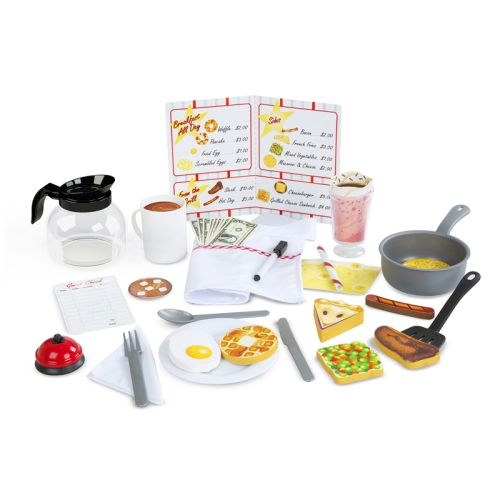 Your price for this item is $57.99
 -
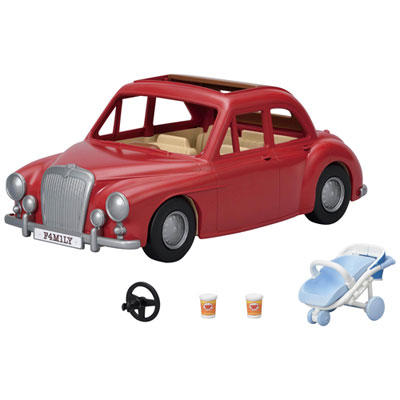 Your price for this item is $28.98
 -
 Your price for this item is $152.98
 -
 Your price for this item is $95.19
 -
 Your price for this item is $85.99
 -
 Your price for this item is $32.99
 -
 Your price for this item is $136.46
Discover more categories related to Wooden Tool Sets
Top Collections:
Pokemon Centers, Kindle Devices, Best Budget Office Chairs, Apple iPhones 16, Best Laptops for Writers, iPhone 15 Apple, Canon G7X Cameras, Refurbished Apple Laptops, Alarm Clock, Motorola Razr Phones
Some products may be subject to Environmental Handling Fees
(EHF) depending on your province.
Learn more about EHFs.