Ice Melt for Walkways

Find walkway ice melt for managing ice on smaller residential paths, sidewalks and entrances. Compare formulas and package options, then check each treatment’s documented uses, surface compatibility and application directions. Choose a quantity that suits the area you maintain and the storage space you have available.

Sort

Why ice melt works better on some paths

Ice melt for walkways helps loosen the bond between ice and the surface beneath it, making a thin glaze easier to clear from front walks, steps and paths between buildings. Unlike sand or traction grit, which gives footwear a rougher surface to grip, most granular ice melts work by forming a salty liquid that freezes at a lower temperature than plain water. The ingredients affect how well that process works in different conditions. Sodium chloride, often called rock salt, can be suitable for relatively mild freezes, while formulas containing calcium chloride or magnesium chloride can work at lower temperatures. Blends vary, so the working temperature printed on the package is more useful than the ingredient name alone. Pavement temperature matters too: a path along the shaded side of a garage can stay icy after a sunny front walk has cleared, even though both are exposed to the same air temperature. The kind of ice makes a difference as well. A light glaze left by freezing rain is different from a ridge of packed snow that has hardened where a driveway meets the sidewalk. Ice melt can help free that ridge from the pavement, but it won’t take the place of clearing the bulk of the snow. Granule size affects how easily the material spreads. Larger pellets are easier to see against dark pavement, which can help show where they’ve landed, while finer granules can be easier to distribute across a narrow tread or an awkward corner. The application rate on the package gives a better sense of how much to use than the appearance of the surface alone. A short path from the curb to the front door and a long, shaded walkway serving several entrances present different needs, even if the same formula suits both.

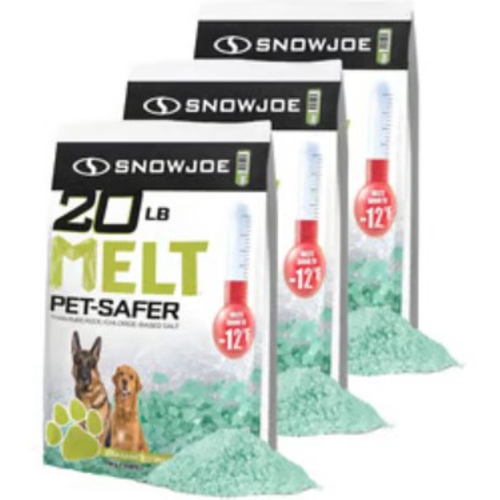
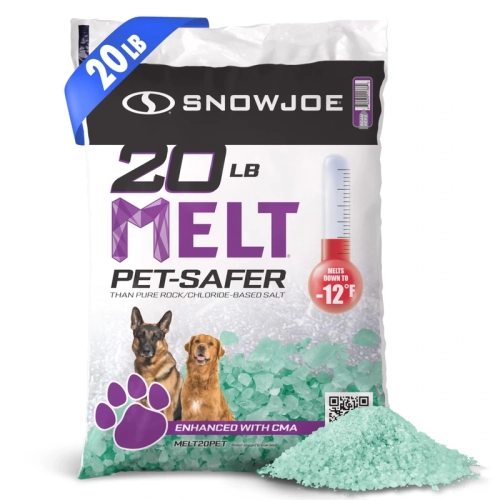
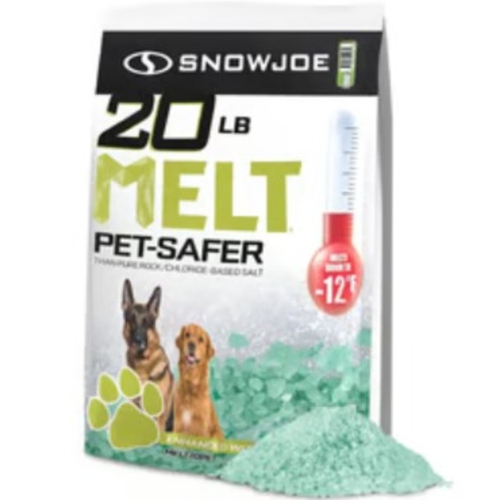
Surface compatibility matters as much as melting performance. A single route from the sidewalk to the door might cross poured concrete, a paver landing and painted steps, with a metal threshold at the entrance. A formula suited to one of those surfaces may not be suitable for the others. Check the restrictions on the package against the care instructions for the walkway, particularly if the concrete is new, the stone is porous or the finish is sealed. Freeze-thaw cycles are already hard on concrete with cracks or flaking edges, and some de-icers can contribute to further surface damage. Rough or uneven paving can also hold granules in joints and low spots, so what looks like a light scattering across the top may be more concentrated along the edges. Foot traffic brings a different set of considerations. On a front path used by children, visitors and delivery workers, loose granules and slush can travel from the bottom step to the entry mat in a few trips. A mat helps catch residue, and clearing the loosened slush keeps it from collecting where people stop to unlock the door. Households with dogs may want to pay particular attention to the patch beside the steps or gate where a dog stands waiting to be let in. A formula labelled for use around pets still calls for following the package directions, limiting contact with treated areas where practical and wiping paws after a walk. Keep ice melt in its original, labelled container with the bag closed or the lid secured, in a dry spot out of reach of children and pets. Some formulas readily absorb moisture, leaving a solid lump at the bottom of a bag that is difficult to spread evenly. For a narrow set of steps, a container that’s easy to grip and pour from while wearing winter gloves can be as practical a consideration as the granules inside.

Walkway ice melt is useful for homeowners keeping a front path clear, tenants responsible for their own entrance and property caretakers looking after several routes on the same site. The way a path is used helps determine where treatment is most useful. A household that enters through a side door may pay more attention to the short turn between the driveway and the steps than to the front walk. At a building with a shared entrance, the landing where people pause and the slope leading to it deserve as much attention as the flat pavement. Drainage can make those spots harder to keep clear. Meltwater from an uphill patch can cross an untreated stretch and freeze again, leaving a narrow strip of ice even after most of the path is bare. Ice melt works best as part of a routine that accounts for where snow is piled and where loosened slush can be moved without sending it across another walking route. A shovel is useful for snow and soft slush, while Walkway Ice Choppers can help break up stubborn, bonded ice on surfaces that can withstand the tool. For an older paver walk or a decorative finish, the surface care instructions can help determine whether a scraping tool is appropriate. If lingering ice is too cold for a particular formula to work effectively, traction grit can help improve footing without melting the ice. The most practical choice of ice melt comes down to the conditions on the route itself: how cold the pavement gets, what it’s made of and whether the usual trouble spot is a light glaze on a landing or a hard band of ice where the path meets the driveway.

FAQ

Some products may be subject to Environmental Handling Fees (EHF) depending on your province. Learn more about EHFs.